

Timing Belt Before Financing an Older Model?
When you are exploring financing options for an older used vehicle, the conversation often centers on mileage, condition, and payment terms. However, one of the most critical, yet frequently overlooked, components is the timing belt. This unassuming rubber belt is the heart of your engine’s rhythm, ensuring that all its internal parts move in perfect harmony. In many older models, a timing belt has a specific service life, and failing to replace it on schedule can lead to catastrophic and costly engine failure. Asking the right questions about this part before you sign any financing paperwork is not just smart, it is a crucial step in protecting your investment and preventing a potential financial disaster down the road. An unexpected, four-figure repair bill can turn an affordable vehicle into a significant burden, making this one conversation you cannot afford to skip.
Understanding the status of a vehicle’s timing belt provides you with powerful knowledge. It allows you to more accurately assess the true cost of ownership and gives you significant leverage in your purchase decision. A car with a recently replaced timing belt offers peace of mind and predictable maintenance costs, while one with an overdue belt represents a looming expense. Being informed empowers you to budget correctly, choose the right vehicle from our used inventory, and drive away confident in the reliability of your newly financed car.
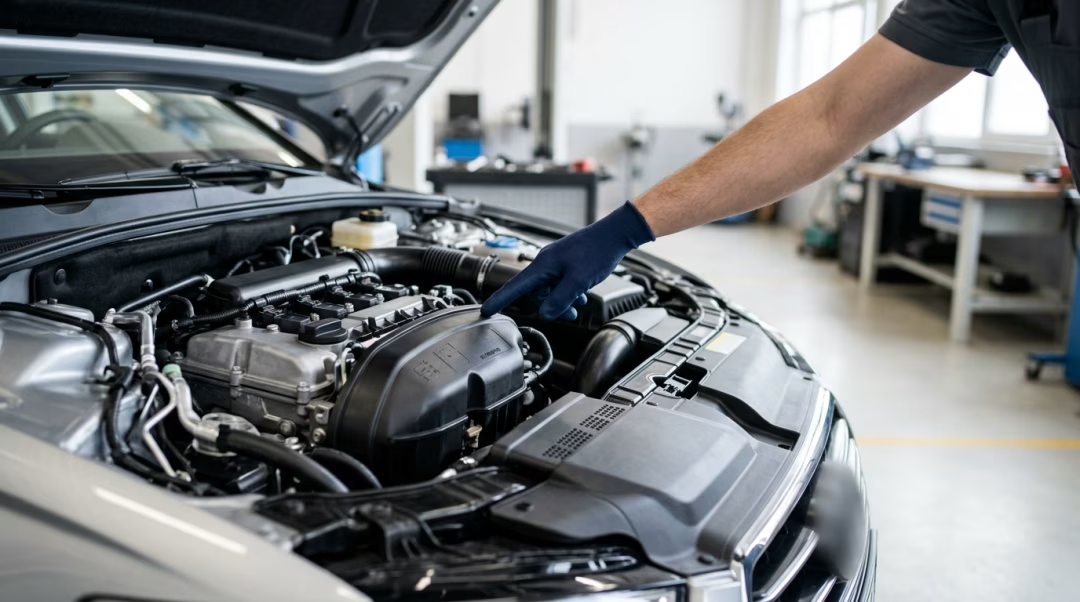
The Engine's Pacemaker: Why the Timing Belt is So Important
Deep inside most internal combustion engines is a component that works tirelessly, unseen and often unthought of, until it fails. This part is the timing belt. Its job sounds simple but is absolutely vital: it synchronizes the rotation of the engine's crankshaft and camshafts. This precise timing ensures that the engine's valves open and close at the exact right moments in relation to the pistons' movements. In an interference engine, which is a very common design, the space occupied by the valves when open and the pistons at the top of their stroke is shared. The timing belt guarantees they are never in that space at the same time. Made from a durable, reinforced rubber compound, it is a wear-and-tear item with a manufacturer-recommended replacement interval, typically ranging from 60,000 to over 100,000 miles.
When a timing belt snaps or strips its teeth, that perfect synchronization is instantly lost. The pistons can slam into the open valves, causing widespread internal damage. This can result in bent valves, damaged pistons, or even a completely destroyed cylinder head. The repair for this type of failure is not just an inconvenience; it is one ofthe most expensive engine repairs possible and can often cost more than the value of an older vehicle, turning your reliable transportation into a driveway ornament overnight.
Key Questions to Ask About the Timing Belt
When you are ready to get pre-qualified for an older model, being prepared with the right questions is essential. It demonstrates that you are a savvy buyer and helps you avoid costly surprises. Here is what you need to ask about any vehicle that uses a timing belt instead of a timing chain.
- Has the timing belt been replaced on this vehicle? This is the most direct and important question. A simple yes or no answer sets the stage for your follow-up inquiries.
- Do you have the service records to prove it? Talk is cheap. Verifiable proof is what matters. This could be an invoice from a repair shop, a receipt for the parts, or a sticker in the engine bay from the technician who performed the work. This documentation should ideally show the date and the mileage at the time of service.
- Were the related components replaced at the same time? A professional timing belt job involves more than just the belt. It is standard practice to replace the water pump (which is often driven by the timing belt), the tensioner, and any idler pulleys. These parts are known as a "timing belt kit," and since they have similar lifespans and are labor-intensive to access, replacing them all at once is the most cost-effective approach.
- What is the manufacturer's recommended service interval for this model? Knowing when the manufacturer suggests replacement gives you context. If a belt was replaced 50,000 miles ago and the interval is 90,000 miles, you have plenty of life left. If it was replaced 80,000 miles ago, you will need to budget for another replacement soon.
Connecting the Dots to Your Auto Loan
The condition of the timing belt is directly tied to the financial health of your auto loan. A typical timing belt replacement service can cost anywhere from $700 to $1,500 or more, depending on the vehicle's make and the complexity of the engine. If you finance a car that is due, or overdue, for this service, you are essentially financing a hidden, time-sensitive repair bill. This unexpected expense can strain your budget, making it difficult to keep up with payments and other ownership costs like insurance and fuel. This is especially critical in a Buy Here Pay Here financing situation, where maintaining a steady payment history is paramount. Asking these questions before you sign allows you to factor this potential cost into your decision. You might decide to look for a different vehicle, or you can use the information to better plan your budget for the first year of ownership.
What if There Are No Records?
It is common for older vehicles, especially those that have had multiple owners, to have incomplete service histories. If the dealership has no record of a timing belt replacement, your safest course of action is to assume it has not been done. You cannot rely on a visual inspection, as the belt is hidden behind protective covers and can look perfectly fine right up until the moment it fails. In this scenario, you must factor the full cost of a timing belt service into the total purchase price of the vehicle. This information is vital when comparing two similar cars. A vehicle that is $500 more expensive but has proof of a recent timing belt service is often a much better value than a cheaper one with an unknown history. Our team is committed to transparency and will help you understand the service history of any vehicle you are interested in. We believe an informed customer is a happy customer, which is a core part of our philosophy you can learn more about on our about us page.
Frequently Asked Questions About Timing Belts
What happens if a timing belt breaks while I am driving?
If a timing belt breaks on an interference engine while it is running, the engine will shut off immediately. Internally, the pistons will continue to move for a few rotations and will strike any valves that were left in the open position. This causes severe, and often irreparable, engine damage. You will lose all power and will need to have the vehicle towed to a repair shop for a costly diagnosis and repair.
How much does a typical timing belt replacement cost?
The cost varies widely depending on the make and model of the car. For a simple four-cylinder engine, the cost might be in the $600 to $900 range. For more complex V6 or V8 engines where the belt is harder to access, the cost can easily exceed $1,200 to $1,500. It is always wise to get a quote for the specific vehicle you are considering.
Can I see the timing belt before I buy the car?
Generally, no. The timing belt is located behind a series of plastic or metal covers in the front of the engine bay. Accessing it for a visual inspection requires a significant amount of labor, essentially the first step of replacing it. Therefore, a visual inspection is not a practical part of the pre-purchase process, which is why relying on service records is so critical.
If a car has a timing chain, do I need to worry about it?
While timing chains are designed to last the life of the engine, they are not completely immune to problems. The plastic guides and hydraulic tensioners that keep the chain tight can wear out or fail over time, especially on high-mileage vehicles or those with poor maintenance histories. While a chain failure is less common than a belt failure, it is still something to be aware of, and unusual engine noises like rattling on startup can be a warning sign.
Why is replacing the water pump with the timing belt so important?
In many engine designs, the timing belt also drives the water pump. The labor required to access the timing belt is identical to the labor needed to access the water pump. Since water pumps are also wear-and-tear items, replacing it at the same time as the belt is a preventative measure that saves you from paying for the same labor-intensive job twice if the water pump fails later on.
