

Between a Sedan and an SUV?
Choosing your next vehicle involves balancing style, utility, and budget. One of the most significant ongoing costs of ownership is car insurance, and many drivers wonder how rates differ between popular body styles. When comparing sedans and SUVs, insurance costs are not always straightforward. While you might assume a larger, more expensive SUV automatically carries a higher premium, this is often not the case. Insurance companies analyze a complex set of risk factors for each specific model, including repair costs, safety ratings, and even theft statistics. Understanding these key variables is the first step toward predicting how your choice between a sleek sedan and a versatile SUV will impact your monthly insurance payment. The answer depends less on the vehicle type and more on the specific details of the model you are considering for your daily driving needs.
Ultimately, the premium you are quoted will be a unique calculation based on the vehicle itself, your personal driving history, and where you live. While generalizations can provide a starting point, the most effective way to compare costs is to get quotes for the specific models you are interested in. By exploring our extensive used inventory, you can identify a few sedans and SUVs that fit your lifestyle and then reach out to your insurance agent for precise figures before making a final decision.
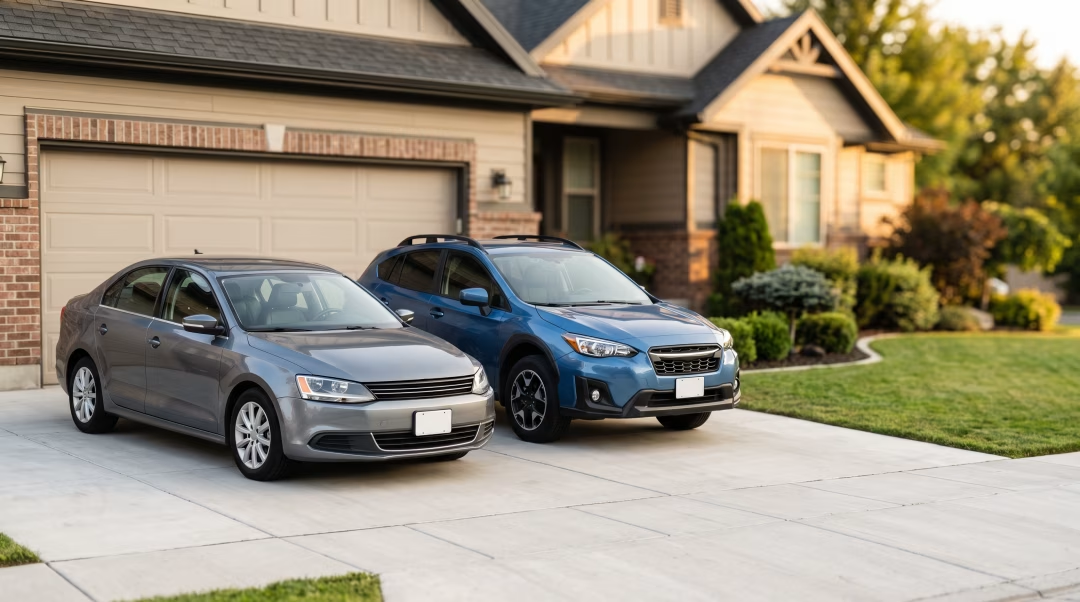
A Deeper Dive into Sedan vs. SUV Insurance Premiums
When you begin shopping for a pre-owned vehicle, the sticker price is just the beginning of the story. The total cost of ownership includes fuel, maintenance, and, of course, insurance. The debate between a sedan and an SUV is a common one, with each offering distinct advantages. Sedans often provide better fuel economy and a smoother ride, while SUVs deliver more cargo space and a commanding view of the road. But how does this choice influence your insurance costs? The answer is nuanced, as insurers look far beyond the simple classification of "sedan" or "SUV" when setting their rates. They use a sophisticated risk assessment model that evaluates dozens of data points to determine the likelihood of a claim and the potential cost of that claim.
Before we compare the two vehicle types directly, it is crucial to understand the foundational elements that all insurance carriers use to calculate your premium. These factors apply whether you are insuring a compact coupe or a three-row minivan. By learning what insurers prioritize, you can better understand why a compact SUV might be cheaper to insure than a luxury sedan, or vice versa. This knowledge empowers you to make a more financially sound decision that aligns with your long-term budget. If you are starting your financial planning, getting an idea of your options is a great first step. You can easily get pre-qualified to see what fits your budget.
Key Factors That Determine Vehicle Insurance Costs
Insurance companies are in the business of managing risk. The premium they charge you is a direct reflection of the risk they believe you and your chosen vehicle represent. Here are the primary vehicle-specific factors they analyze:
- Vehicle Value and Purchase Price: This is one of the most straightforward metrics. A more expensive vehicle costs more to replace if it is stolen or totaled in an accident. Therefore, the collision and comprehensive portions of your policy will almost always be higher for a vehicle with a higher market value.
- Cost of Repairs: Insurers keep extensive databases on the cost to repair every make and model. Vehicles with parts that are expensive or hard to source will cost more to insure. This includes vehicles with advanced driver-assistance systems (ADAS), as replacing a windshield with embedded sensors or a bumper with radar units is far more costly than on a base model vehicle. Before you buy, it is wise to learn what to check under the hood for signs of previous, costly repairs.
- Safety Ratings: The Insurance Institute for Highway Safety (IIHS) and the National Highway Traffic Safety Administration (NHTSA) perform rigorous crash tests. Vehicles that earn high marks are proven to protect occupants better, reducing the likelihood of expensive medical claims. Insurers often provide discounts for vehicles with top-tier safety ratings and features like automatic emergency braking and blind-spot monitoring.
- Theft Rates: Some vehicles are statistically stolen more often than others. The Highway Loss Data Institute (HLDI) publishes data on theft claims. If the model you are considering is a frequent target for thieves, the comprehensive portion of your insurance premium will be higher to cover that increased risk.
- Liability Risk: This refers to the amount of damage a vehicle can inflict on others in an accident. Larger, heavier vehicles like many SUVs have the potential to cause more significant damage to other cars and property, which can lead to higher liability insurance costs.
Comparing the Costs: Sedan vs. SUV
With those factors in mind, we can now explore the specific arguments for why each vehicle type might cost more or less to insure. There are no absolute rules, and the final cost will always come down to the exact make, model, and trim level you choose.
Why an SUV Can Be More Expensive to Insure
Generally, SUVs tend to have slightly higher insurance premiums than sedans of a similar class. A primary reason is their higher average purchase price. A mid-size SUV typically has a higher MSRP than a mid-size sedan, leading to higher replacement costs. Furthermore, their increased size and weight contribute to greater liability risk. In a collision with a smaller vehicle, an SUV is likely to cause more damage, leading to larger potential claims that insurers must price into their liability coverage rates. Repair costs can also be a factor, particularly for all-wheel-drive (AWD) systems, larger tires, and more complex body panels. If you are deciding between a sedan and a crossover, our guide on sedan versus crossover can provide more insight into daily use.
When a Sedan Might Cost More to Insure
However, the script can easily flip. Many of the most popular and frequently stolen vehicles in the country are mid-size sedans. High theft rates for models like the Honda Accord or Toyota Camry can drive up comprehensive insurance costs, sometimes making them more expensive to insure than a comparably priced compact SUV. Additionally, the "sedan" category includes high-performance and luxury sports models. A sedan with a powerful V6 or V8 engine will often carry a much higher premium than a family-focused SUV with a modest four-cylinder engine due to the perceived risk associated with speed and aggressive driving. Insurance companies associate horsepower with a higher likelihood of accidents and traffic violations, leading to increased rates.
The Importance of Comparing Specific Models
This analysis shows that broad labels are not helpful. You cannot assume an SUV will cost more than a sedan. A base model Subaru Forester will likely be significantly cheaper to insure than a BMW 5 Series sedan. An older Toyota RAV4 could have lower premiums than a brand new Kia K5. The key is to narrow your search to a few specific vehicles that meet your needs. Once you have a shortlist, contact your insurance agent with the Vehicle Identification Numbers (VINs) to get actual quotes. This is the only way to know for sure how your insurance costs will be affected. While you are budgeting, you can also value my trade to see how much your current vehicle can offset the cost of your next one.
Frequently Asked Questions About Vehicle Insurance Costs
Are smaller SUVs always cheaper to insure than large sedans?
Not necessarily. While a smaller SUV may have a lower purchase price, a large sedan with exceptional safety ratings and low theft rates could have a lower premium. Factors like repair costs and the specific engine type play a huge role. Always compare quotes for specific models rather than relying on vehicle category alone.
How much do safety features like lane-assist and automatic braking affect insurance?
These features can have a significant positive impact. Many insurance companies offer specific discounts for advanced driver-assistance systems (ADAS) because they are proven to reduce the frequency and severity of accidents. This can lower both your collision and liability premiums, making a vehicle equipped with them cheaper to insure over the long term.
Does the trim level of a sedan or SUV impact the insurance rate?
Yes, absolutely. A higher trim level typically means a more powerful engine, more expensive features like a panoramic sunroof or premium sound system, and a higher overall vehicle value. All of these factors increase the potential cost of a claim, leading to a higher insurance premium compared to the base model of the same vehicle.
Will my insurance go up if I switch from a sedan to a similar-priced SUV?
It might, but it could also go down or stay the same. If the SUV has better safety ratings, is less expensive to repair, and has lower theft rates, your premium could decrease. However, if the SUV has a higher liability risk profile due to its size and weight, your premium might increase slightly. The only way to know for sure is to get a quote.
Do insurance companies view family-oriented SUVs as less risky than sporty sedans?
Generally, yes. Insurers analyze data on how different vehicle types are driven. A three-row family SUV is statistically less likely to be involved in a high-speed accident than a sports sedan with a powerful engine. This difference in driver behavior and risk profile is often reflected in lower insurance rates for the more family-focused vehicle, assuming other factors are equal.
